What is Handheld Echocardiography?
Handheld Echo
Portable ultrasound technology that enables cardiac imaging at the point of care.
Cardiovascular diseases (CVDs) are responsible for about ⅓ of deaths in the world, with over 75% of those deaths occurring in low- and middle-income countries. This constitutes a major problem worldwide that needs a solution. One of the best solutions is early detection.
Early detection is like finding a leak in the roof before the ceiling collapses. The earlier a disease is diagnosed, the more options there are for treatment and the greater the chance of preventing serious or permanent damage. In some cases, this can even allow patients to avoid surgery or other invasive treatments. This is especially important for valvular heart disease, which can be lethal if left untreated, but if the intervention is performed early enough, the patient can still have a near-normal life-expectancy. Moreover, population-based cardiovascular screening programmes have been associated with lower mortality rates, fewer cardiovascular events, and reduced hospitalization compared with non-screened populations.
Echocardiography is central to cardiac assessment, but conventional systems can be costly, time-consuming, and difficult to access. Handheld Echocardiography (HHE) offers a more portable approach to cardiac imaging. Using devices that can be as small as a smartphone, it allows cardiac ultrasound examinations to be performed directly at the point of care rather than exclusively in dedicated echocardiography laboratories. This means imaging can be brought to the patient, whether at the bedside, in an ambulance, or in primary care settings. By increasing portability and accessibility, HHE has expanded the use of cardiac ultrasound beyond traditional hospital environments and made quick cardiovascular assessment possible in a wider range of clinical situations.
Bringing Echocardiography to the Patient
Handheld Echocardiography (HHE) allows the examinations not to be limited to specialised cardiology departments and echo labs. Thanks to its portability, the cardiac imaging can be now brought to the patient at the point-of-care, be it at the bedside, in primary care, ambulances, or in community settings.
It is particularly useful in the regions where cardiologists and sonographers are scarce. In many cases, there is less than one cardiologist per a million people, and even then, specialists are mainly located in urban areas, leaving rural populations with limited access to care. Standard echocardiography is often not available due to high equipment costs (around 50,000 USD), weak infrastructure, unstable electricity supply, and poor internet access. The limited access to cardiovascular care is reflected in the fact that most CVD-related deaths occur in low- and middle-income countries.
However, in these resource-constrained settings, examinations would most likely be performed by non-expert operators, i.e. people who do not have extensive training and experience in standard echocardiography (SE), such as nurses, GPs, or community healthcare workers. That is, of course, not to say that they would not be trained. Thanks to HHE’s ease of use, examinations can be successfully performed following structured training without the need for extensive experience in SE.
The effectiveness of HHE used by non-experts can be further enhanced by the increasing incorporation of AI into these devices. AI can guide the operator in real time, recognise standard echocardiographic views, assess image quality, and prompt the user to reacquire an image when necessary. By helping with both image acquisition and quality control, AI can make it easier for less experienced operators to obtain diagnostically useful images. This can further lower the level of expertise needed for an initial examination and, in turn, increase access to cardiac imaging.
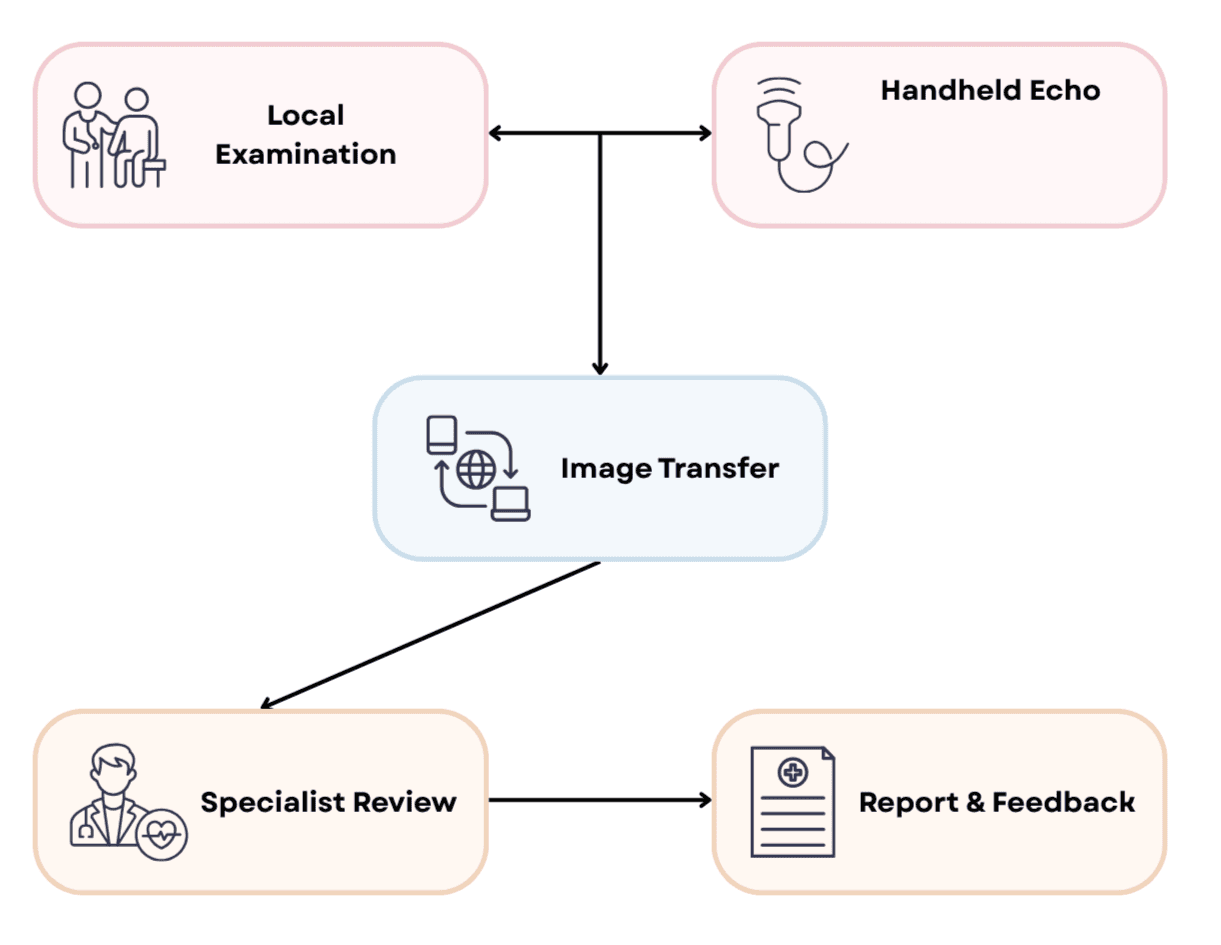
An important aspect to mention is the role of HHE in telemedicine, or, in this case specifically, tele-echocardiography. But what is that, you may ask? The whole thing boils down to this: the examination is performed at the point of care by a local medical professional and then sent for remote interpretation by a specialist. This is particularly beneficial for remote areas, where travelling to a hospital or another location with specialist services may not be feasible for the patient.
Together, these applications allow HHE to extend cardiac imaging beyond traditional echocardiography settings. Its portability, ease of use, and compatibility with AI and telemedicine make it particularly suited to situations where access to conventional cardiac imaging is limited.
How Good Is HHE?
Significant valvular pathologies were detected in 82% of patients when using HHE, compared to 47% for physical examinations. This shows that handheld echocardiography can provide the medical professionals with more diagnostic information than physical examination alone. text goes here.
A large systematic review that included approximately 15,578 unique participants, found that when using the HHE to diagnose rheumatic heart disease (RHD), it demonstrated high overall diagnostic accuracy of 94% compared to standard echocardiography (SE). When used for screening the accuracy was somewhat lower (90%) but still remained high. One important thing to note is that it performed a bit worse for patients with very early or borderline disease.
The same review, also showed that, despite a slight reduction in diagnostic accuracy compared with expert operators, HHE used with simplified echocardiographic protocols or by non-expert operators following a structured training programme still achieved good diagnostic performance for RHD.
According to certain studies, AI probe guidance helped non-expert operators obtain diagnostically accurate images in over 90% of examinations. In other words, real-time guidance and automatic quality assessment help operators obtain standard views more consistently, making it easier to acquire diagnostically useful images. . In a prospective multicentre study of 867 patients with suspected heart failure, AI-assisted analysis of handheld echocardiograms achieved 93% diagnostic accuracy for detecting an LVEF of 40% or less. For this specific assessment, AI analysis of handheld scans was found to be comparable to expert analysis of standard cart-based scans.
HHE can act as a sort of “gatekeeper” to standard echocardiography by identifying the patients that actually require comprehensive examination, thus reducing the need for standard echo by even 46%. This can make HHE cost-effective in the long run, as the cost of one HHE examination was estimated to range from $11 to $116, compared with $170 to $1,500 for SE.
| HHE | Result |
|---|---|
| Valvular pathology detected | 82% |
| RHD diagnostic accuracy | 94% |
| RHD screening accuracy | 90% |
| AI-guided adequate examinations | >90% |
| Reduction in SE referrals | up to 46% |
All in all, this evidence shows that HHE can be an effective screening and triage tool, particularly where access to echocardiography is limited. Its relatively low cost and high diagnostic performance make it especially valuable when HHE is used by trained non-experts to extend access to cardiac imaging.
The Bigger Picture
Handheld echocardiography is best used for screening, triage and focus assessment. It does not replace the need for standard echocardiography, as SE is still needed for complex cases, especially those that require Doppler-dependent measurements or involve patients with poor acoustic windows. HHE should therefore be viewed as a complement to, rather than a replacement for, comprehensive echocardiography.
Implementation of AI lowers the barrier for non-expert operators, but does not eliminate the need for training in image acquisition, interpretation and reporting that minimises the risk of over- or under-diagnosis. AI can make HHE easier to perform, but it does not make operator training unnecessary.
Moreover, AI integration is still a new development and is not available in all of the devices, and those capabilities also vary further between manufacturers. The same is true for Doppler, with significant differences in the capabilities offered by individual devices. This means that not all HHE systems provide the same diagnostic possibilities.
Tele-echocardiography is another promising development, but what’s stopping it from being more widely adopted is not the insufficiency of HHE, but the infrastructural difficulties. This solution needs stable electricity and internet access, and even more importantly, telemedicine requires the creation of secure data transfer systems and legal and data protection frameworks. Without these, even the most capable system is not safe to be used.
Lastly, since the technology is still new and not that widely adopted, the evidence supporting it is still mostly limited to specific applications such as rheumatic heart disease. Direct comparison with high-end stationary echocardiography is also limited. More evidence across different diseases and settings is needed, but what we have now is indeed promising.
Overall, HHE’s best value lies in extending access to cardiac imaging in places where standard echocardiography is very difficult to access. It is best suited for focused examinations that help identify which patients require a more comprehensive examination.